 VacationSage
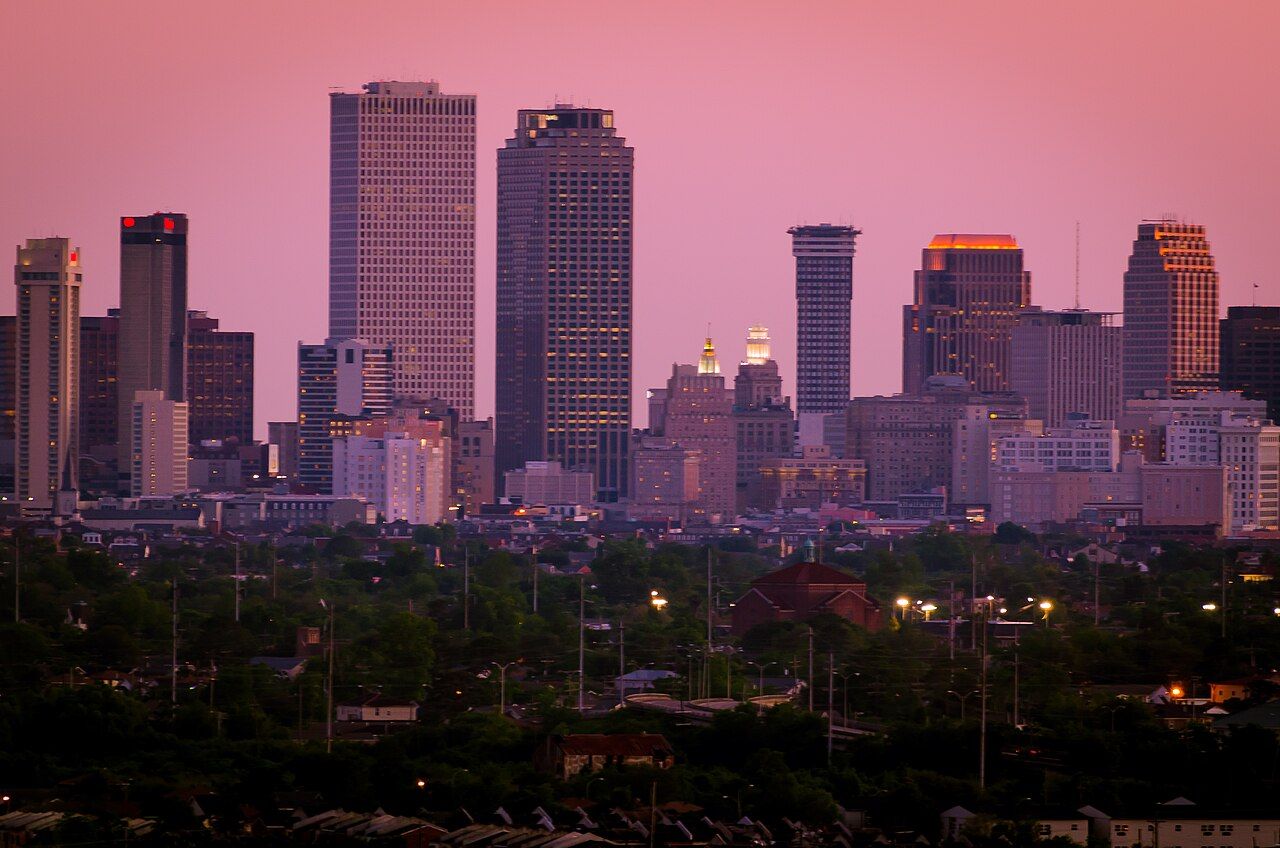
The year at a glance
ExcellentGoodFairPoor Click a month to compare destinations.
The short answer
Go in March–April, October–November. The least comfortable stretch is June–September.
- Warmest month: July, average high 34°C (92°F).
- Coolest month: January, average high 18°C (64°F), lows near 6°C (44°F).
- Wettest month: August, about 198 mm (7.8 in) of rain.
- Driest month: October, about 97 mm (3.8 in).
Quick facts
- Currency
- United states dollar
- Plugs
- Type A, Type B
- Drives on the
- right
- Calling code
- +1
- Airports
- Louis Armstrong New Orleans International Airport (MSY)
- Population
- 383,997
Temperature and rain through the year
Average highAverage lowRain (mm, right axis)
Top sights in New Orleans
- St. Louis Cathedral cathedral in New Orleans, USA
- Lake Pontchartrain estuary located in southeastern Louisiana, United States
- New Orleans Museum of Art art museum in New Orleans, Louisiana
- Congo Square square in New Orleans, Louisiana USA
- Jackson Square historic park in New Orleans, Louisiana, United States
- Hancock Whitney Center skyscraper in New Orleans, Louisiana
- The Cabildo historic building in New Orleans, Louisiana
- Six Flags New Orleans abandoned theme park in New Orleans, Louisiana
Ranked by how widely each place is covered across Wikipedia's language editions, a rough measure of fame rather than a recommendation.
Travel advisories
United States
The U.S. State Department does not issue advisories for travel within the United States.
United Kingdom
No FCDO warning against travel to any part of United States.
Latest change (2026-10-30): Updated information about Ebola (‘Entry requirements’ page).
Checked 2026-11-02.
Advisories are summarised from official sources and can change quickly; always read the source before you travel.
Month by month
| Month | Score | High | Low | Rain | Cloud | Dew point | Daylight |
|---|---|---|---|---|---|---|---|
| January | 5.5 Fair | 18°C 64°F | 6°C 44°F | 137 mm 5.4 in | 39% | 8°C47°F dry | 10.3 h |
| February | 6.5 Good | 20°C 68°F | 8°C 47°F | 152 mm 6.0 in | 39% | 11°C52°F comfortable | 11.0 h |
| March | 8.5 Excellent | 23°C 74°F | 12°C 53°F | 112 mm 4.4 in | 34% | 13°C55°F comfortable | 11.8 h |
| April | 8.4 Excellent | 27°C 80°F | 15°C 59°F | 118 mm 4.7 in | 29% | 16°C60°F comfortable | 12.7 h |
| May | 6.7 Good | 30°C 87°F | 19°C 67°F | 125 mm 4.9 in | 28% | 20°C67°F muggy | 13.5 h |
| June | 2.8 Poor | 33°C 91°F | 22°C 72°F | 195 mm 7.7 in | 30% | 22°C72°F oppressive | 13.9 h |
| July | 2.4 Poor | 34°C 92°F | 24°C 74°F | 186 mm 7.3 in | 34% | 24°C74°F oppressive | 13.7 h |
| August | 2.2 Poor | 34°C 92°F | 24°C 75°F | 198 mm 7.8 in | 35% | 24°C74°F oppressive | 13.1 h |
| September | 4.6 Poor | 32°C 89°F | 22°C 71°F | 155 mm 6.1 in | 29% | 22°C71°F oppressive | 12.2 h |
| October | 8.8 Excellent | 28°C 82°F | 16°C 62°F | 97 mm 3.8 in | 26% | 17°C62°F sticky | 11.3 h |
| November | 8.5 Excellent | 23°C 73°F | 11°C 52°F | 110 mm 4.4 in | 29% | 12°C54°F comfortable | 10.5 h |
| December | 6.5 Good | 19°C 66°F | 8°C 46°F | 127 mm 5.0 in | 37% | 10°C49°F dry | 10.1 h |
Public holidays in the next 12 months
Holidays can mean closures, festivals and busier transport. National and regional (LA) public holidays for United States; school holidays are not included.
- November 2026
- Election Day
- Veterans Day
- Thanksgiving
- December 2026
- Christmas Day
- January 2027
- New Year's Day
- Martin Luther King Jr. Day
- February 2027
- Mardi Gras
- Washington's Birthday
- March 2027
- Good Friday
- May 2027
- Memorial Day
- June 2027
- Juneteenth National Independence Day (observed)
- Juneteenth National Independence Day
- July 2027
- Independence Day
- Independence Day (observed)
- September 2027
- Labor Day
More in Americas


Temperature, rain and dew point are 1991–2020 averages from a ~4 km climate grid; cloud cover is a 1981–2010 average. Recent years run warmer in most places, and a single trip can differ a lot. How this is calculated.